
Tag: Florida condo buyers

  • Florida Condo Guide to Emotional Support Animals (ESA)

    Florida Condo Guide to Emotional Support Animals (ESA)

    Emotional support animals can become one of the most confusing issues in Florida condo living, which is why a Florida Condo Guide to the topic matters, because they sit at the intersection of housing rights, association rules, documentation, and daily community life. Many owners assume an ESA can bypass every condo rule automatically. Many boards assume they can reject the request if the building has strict pet restrictions. Both sides often misunderstand the actual framework, and that is where conflict begins.

    At MAK Realty, we see this issue matter for buyers, sellers, landlords, boards, and residents because condo living in Florida is highly rule driven. An emotional support animal request is not only about the animal. It is also about fair housing compliance, building process, resident expectations, and how the condo community handles accommodation requests without creating unnecessary legal or practical problems. The smartest approach is to understand what an ESA is, what it is not, and how the request should be handled from the start.

    What an Emotional Support Animal Is

    An emotional support animal is an animal that provides comfort or emotional support connected to a person’s disability. In housing, that can matter because a resident may request the animal as a reasonable accommodation even if the condo has pet restrictions, breed limits, or size limits that would otherwise apply.

    This is one reason the issue becomes so misunderstood. Many people treat emotional support animals as if they are simply pets with a different label. In the housing context, that is not the right framework. The legal question is not whether the board likes the animal. The question is whether the request qualifies as a reasonable accommodation under fair housing standards.

    What an Emotional Support Animal Is Not

    An emotional support animal is not the same as a service animal. That distinction matters. A service animal is generally associated with specific trained work or tasks related to a disability. An emotional support animal is usually tied to support, comfort, or emotional benefit rather than task specific training.

    This matters for condo communities because people often use the terms interchangeably when they should not. The rights involved can overlap in some housing settings, but the definitions are still different. A board, owner, or resident who confuses the two can easily mishandle the issue.

    Why This Matters So Much in Florida Condos

    Florida condos tend to have detailed governing documents. Pet restrictions, registration rules, common area rules, and occupancy expectations are often tightly written. That makes ESA requests especially sensitive because the association may feel it is being asked to override the rules it relies on to manage the building.

    For residents, the issue can feel equally personal. Someone requesting an ESA may believe the need is obvious and urgent. Other residents may feel the board is applying the rules unevenly. This is why clarity matters. An ESA request is not just a pet issue. It is a housing accommodation issue inside a rule heavy environment.

    Pet Rules Do Not Automatically Control an ESA Request

    One of the biggest misconceptions is that a no pets building can simply reject an ESA request because the governing documents prohibit animals. That is not how the analysis usually works. If the request qualifies as a reasonable accommodation, the association may need to make an exception to its pet policy.

    This does not mean every claimed ESA must be accepted without question. It means the board should not stop the review just because the rules say no pets. The accommodation analysis comes first. The condo documents do not automatically end the discussion.

    Documentation Matters

    A resident requesting an emotional support animal usually needs to provide reliable documentation supporting the need for the accommodation. In practice, that often means showing that the person has a disability related need for the animal and that the animal provides support connected to that condition.

    This is one of the most important parts of the process. The association is generally not required to accept vague claims or purely informal explanations with no supporting basis. At the same time, the board should not demand excessive or improper medical detail. The process needs to stay focused, reasonable, and respectful.

    Boards Should Be Careful Not to Overreach

    Condo boards often make mistakes when they react emotionally or try to investigate far beyond what is actually necessary. A board should not treat an ESA request like a disciplinary problem from the start. It should treat it like a housing accommodation request and evaluate it through that lens.

    Overreaching can create risk quickly. If the association demands too much, responds inconsistently, or appears dismissive of the request, the conflict can become much larger than it needed to be. Process matters just as much as outcome in these situations.

    Residents Should Avoid the Shortcut Mentality

    Residents also make mistakes when they assume the board must accept any ESA claim immediately just because the letters ESA are used. The shortcut mentality usually creates problems. If the documentation is weak, the request is unclear, or the resident tries to bypass the process entirely, the board is more likely to resist and the issue can escalate.

    The stronger path is usually the cleaner one. A resident with a real need should present the request clearly, provide proper support, and stay focused on the housing accommodation itself rather than turning the issue into a battle before the review even starts.

    An ESA Does Not Eliminate All Rules

    Even when an emotional support animal is approved, that does not usually mean the owner or resident can ignore all building rules. Reasonable rules around behavior, waste disposal, common area conduct, noise, and safety can still matter. Approval of the accommodation is not the same as total exemption from all standards of conduct.

    This is important because associations and residents sometimes treat approval as if it ends every conversation. It does not. The animal may be allowed as an accommodation, but the resident still has responsibilities tied to how the animal behaves in the building.

    Behavior Still Matters

    An ESA request is about accommodation, not disruption. If an animal creates real safety issues, repeated damage, persistent noise, or major problems for the community, that can change how the association evaluates next steps. The accommodation does not require the building to accept uncontrolled behavior indefinitely.

    This is one reason communication matters so much. A board should separate the legitimacy of the accommodation request from the behavior of the animal itself, but the behavior issue can still become relevant if it affects the building in a serious way.

    Landlords and Unit Owners Need to Understand the Difference

    In a condo, the issue can become even more layered when the unit is rented. A landlord may assume the building will handle the issue. The association may assume the unit owner should deal with the tenant. The tenant may not understand which rules come from the lease and which come from the condo.

    That is why owners need to stay actively informed. If you are leasing a condo unit, the ESA issue is not only between the tenant and the board. The owner often sits in the middle and needs to understand both the fair housing side and the building compliance side clearly.

    Buyers Should Ask About This Before Purchasing

    Buyers do not always think about ESA issues during due diligence, but they should. If a buyer has an emotional support animal or expects that this may become relevant, the building’s process, history, and overall board culture can matter a great deal. Some communities handle these requests more smoothly than others.

    This does not mean a buyer should assume the building can legally ignore the issue. It means the practical ownership experience can still differ building by building. A technically strong legal position does not erase the value of buying into a community that handles sensitive issues competently and calmly.

    Sellers Should Be Ready for Questions

    Sellers may also face questions about ESA rules and pet restrictions during the sales process. If the building has had recent disputes, inconsistent enforcement, or visible conflict around accommodation issues, buyers may become more cautious. In some cases, this does not change the sale directly, but it can shape how buyers view the building’s culture and governance.

    This is one reason building reputation matters so much in condo sales. Buyers are not only buying a unit. They are buying into a system of management, enforcement, and community living. ESA disputes can become part of that larger perception.

    The Best Approach Is a Clear Process

    The best condo communities usually handle ESA issues through a clear process rather than through instinct or frustration. That means written procedures, reasonable review standards, timely responses, and communication that respects both the resident and the association’s responsibilities. The cleaner the process, the lower the chance of unnecessary escalation.

    At MAK Realty, we think that same clarity helps buyers and owners make better decisions before issues arise. A building that handles sensitive accommodation questions responsibly often signals a healthier operating culture overall.

    Why This Matters in the Florida Condo Market

    Florida condo living is already shaped by rules, fees, assessments, insurance pressure, and close community dynamics. ESA issues matter because they sit inside all of that. A mishandled request can create conflict for the resident, risk for the board, and stress for the broader community. A well handled request can avoid most of that.

    For buyers, owners, and investors, the real value comes from understanding that emotional support animal issues are not side topics. They are part of the practical reality of condo ownership in Florida. The strongest position is always to understand the framework before the issue becomes urgent.

    At MAK Realty, we help clients evaluate not only the unit, but also the building culture, rule structure, and ownership realities that come with condo living in Florida. That broader perspective usually leads to smarter and less stressful decisions.

    For a tailored shortlist and next step guidance, connect with MAK Realty.
  • The Florida Condo Special Assessment Survival Guide

    The Florida Condo Special Assessment Survival Guide

    Special assessments are one of the biggest financial shocks condo owners can face in Florida. They often arrive with little emotional warning, even when the signs were already visible in the building’s finances. For buyers, owners, and investors, the real issue is not only the assessment itself. It is the fact that many people do not understand how or why it happens until the bill is already on the way.

    At MAK Realty, we think condo buyers should treat special assessments as a core part of due diligence, not a side issue. In Florida, especially in older or poorly funded buildings, assessments can materially change the cost of ownership. That does not mean every condo is risky. It means every buyer needs a much clearer framework for reading the warning signs, understanding the triggers, and protecting themselves before the problem becomes expensive.

    What a Special Assessment Actually Is

    A special assessment is a charge imposed by the condo association on unit owners to pay for expenses that the regular budget and reserve funds cannot fully cover. These expenses are usually tied to major repairs, structural work, deferred maintenance, insurance increases, code compliance, safety upgrades, or large capital projects.

    This matters because many buyers assume the HOA fee already covers everything. It does not. Monthly dues cover operations and, ideally, some reserve funding. When the association falls short or a major expense appears, owners may be asked to contribute additional money directly. That extra charge is the special assessment.

    Why Florida Condo Owners Face Them So Often

    Florida condo owners face special assessments more often because the buildings themselves face more pressure. Coastal exposure, humidity, salt air, waterproofing issues, concrete maintenance, aging systems, and stricter repair expectations all create a more demanding environment than many inland markets.

    Some buildings also spent years keeping monthly fees too low by underfunding reserves or delaying capital work. That may have felt helpful in the short term, but it often creates a much larger problem later. When major repairs become unavoidable, owners get hit with assessments instead of gradual planning.

    The Biggest Warning Sign Is Weak Reserves

    If there is one thing buyers should understand, it is this. Weak reserves often lead to special assessments. A building that is not saving enough for future major repairs is much more likely to come back to owners later for extra money.

    This is why reserve review matters so much. A building may look beautiful, and the HOA fee may look manageable, but if the reserve account is thin relative to the building’s needs, that lower monthly cost can be deceptive. In many cases, it is simply a delayed bill.

    Older Buildings Need More Scrutiny

    Age alone does not make a condo risky, but it does make reserve review more important. Roofs, elevators, balconies, facades, plumbing, waterproofing, windows, and structural components all age. If the association has not kept pace, the cost of catching up can be substantial.

    That does not mean older buildings should be avoided automatically. Some are very well managed and financially responsible. However, buyers should assume that age increases the importance of reserve strength, maintenance history, engineering review, and pending capital work.

    A Low HOA Fee Can Be a Trap

    One of the most common buyer mistakes is assuming a lower HOA fee means a better deal. Sometimes it does not. In Florida condos, a surprisingly low fee can mean the association is not saving enough, not maintaining enough, or not preparing for predictable future expenses.

    At MAK Realty, we often remind clients that a lower monthly number is only attractive if the building is still healthy behind the scenes. A slightly higher fee in a building with stronger reserves and better planning may be far safer than a lower fee in a building that is quietly heading toward a major assessment.

    What Buyers Should Review Before Closing

    Before buying a Florida condo, buyers should review the budget, reserve schedule, recent meeting minutes, current assessments, planned capital projects, engineering or structural reports if available, and the association’s general financial health. These documents often reveal whether the building is stable or whether pressure is building below the surface.

    The meeting minutes are especially useful because they often show what owners and the board are already discussing. If there is repeated talk of repairs, insurance pressure, deferred maintenance, or financing concerns, that deserves close attention.

    Pending Repairs Matter as Much as Existing Assessments

    Some buyers focus only on whether an assessment has already been issued. That is too narrow. A building may not yet have a formal assessment, but if major repairs are clearly approaching, the financial risk is still real. In some cases, the assessment simply has not been approved yet.

    This is one reason careful reading matters. You are not only looking for what is already charged. You are looking for what is likely coming next. A buyer who ignores pending work can walk into a future obligation that was visible to anyone willing to read the file carefully.

    Insurance Pressure Can Trigger Assessments Too

    Not every special assessment comes from physical repairs alone. In Florida, insurance costs can also put major strain on condo budgets. If a building’s insurance burden rises sharply and the operating budget cannot absorb it smoothly, owners may feel that pressure through higher fees, special assessments, or both.

    This makes condo ownership in Florida more layered than many first time buyers expect. A building may be structurally sound and still face financial pressure from insurance conditions that affect the association’s numbers.

    Sellers and Buyers Need to Negotiate This Clearly

    If a special assessment already exists during a transaction, buyers and sellers need to clarify exactly who is paying what. This should never be left vague. In some deals, the seller pays before closing. In others, there may be negotiation around credits or responsibility.

    A buyer should know not only whether an assessment exists, but also whether another phase may follow later. The current bill is important, but the unfinished project behind it may matter even more.

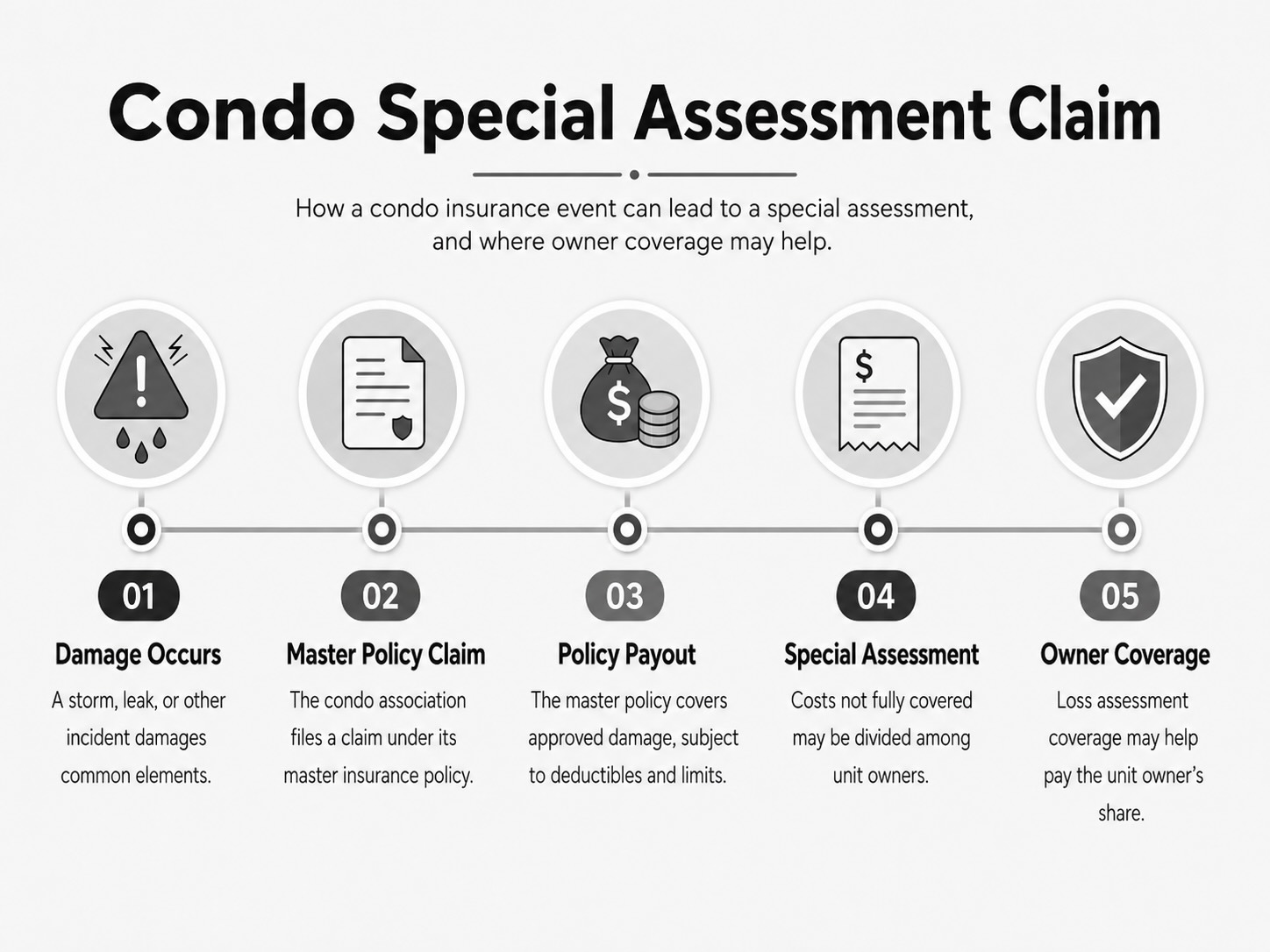
    Owner’s Coverage

    Your loss assessment coverage may pay your allocated share of the special assessment.

    This is one of the most overlooked parts of the conversation. Many owners focus only on the association’s master policy and forget to review their own policy carefully. However, personal condo coverage can sometimes help when a special assessment is passed through to unit owners after a covered loss.

    That does not mean every assessment will be covered. Owners need to understand the limits, exclusions, and terms of their own policy. Still, this coverage can matter greatly when the assessment is tied to an insurable event rather than simple deferred maintenance or long term reserve weakness.

    How Owners Can Survive an Assessment Better

    For current owners, surviving a special assessment starts with understanding the options early. Some assessments can be paid in a lump sum. Others may offer installment terms. Some owners refinance, use savings, or restructure other assets to absorb the cost. The right move depends on the size of the assessment and the owner’s broader financial position.

    The worst approach is usually avoidance. Once an assessment is on the table, the smartest move is to understand the timeline, confirm the payment structure, and evaluate how it affects both short term cash flow and long term ownership plans.

    When an Assessment Does Not Mean You Should Panic

    Not every special assessment means the building is a disaster. Sometimes a well run association raises money for a necessary repair precisely because it is acting responsibly. The key question is not simply whether an assessment exists. It is why it exists, how the board is handling it, and whether the repair strengthens the building’s long term health.

    This is where context matters. A one time assessment tied to clear capital work in a strong building may be very different from repeated assessments in a property with weak reserves, poor planning, and ongoing deferred maintenance.

    Special Assessments Affect Resale Too

    Assessments can affect resale in two ways. First, they directly affect affordability because buyers have to absorb the extra cost or the fear of further charges. Second, they can change how a building is perceived in the market. A property with repeated financial surprises may lose appeal relative to better managed competitors.

    That is why special assessments are not just an ownership issue. They are also a resale and marketability issue. Buyers in Florida increasingly pay attention to building health, and that attention can shape how well a condo performs later.

    The Smartest Protection Is Buying the Right Building

    The best survival guide is really a prevention guide. The strongest protection against special assessment pain is choosing the right building before you buy. A condo with healthier reserves, stronger management, better maintenance history, and more responsible planning gives buyers much more safety than one that simply looks good on the surface.

    At MAK Realty, we help buyers look beyond the unit and evaluate the financial life of the building itself. In Florida, that is not optional. It is one of the clearest ways to avoid expensive surprises and make a much stronger condo decision.

    What This Means for Florida Condo Buyers Now

    Florida condo buyers should assume that building quality is financial quality. A condo is not just a residence. It is also a shared financial system. If that system is strong, ownership can feel stable and predictable. If it is weak, the cost can rise sharply through assessments, higher fees, and repair driven stress.

    The smartest buyers do not just ask whether the condo is beautiful. They ask whether the building is prepared. That is the question that usually matters most once the closing is behind you.

    For a tailored shortlist and next step guidance, connect with MAK Realty.